

Thailand Warehouse Market Expands as Occupancy Reaches 90.2%
16 September 2026
Thailand’s warehouse market enters stronger expansion phase as occupancy reaches 90.2%, with over 426,000 sq m in the pipeline.
Net absorption increased more than sevenfold year-on-year, while occupied space grew faster than total supply. More than 83% of the future pipeline is concentrated in the BMR and EEC.
Knight Frank Thailand reported that Thailand’s ready-built warehouse market entered a stronger phase of expansion in the first half of 2026. Occupied space grew faster than total supply, lifting the nationwide occupancy rate to 90.2%, while net absorption increased to 147,946 sq m from 20,335 sq m in the same period last year—a more than sevenfold increase.
The figures indicate that newly completed supply continued to be effectively absorbed without creating significant vacancy pressure, even as the market prepares to receive a further 426,435 sq m of warehouse space from H2 2026 onwards.
Occupied space outpaces supply growth
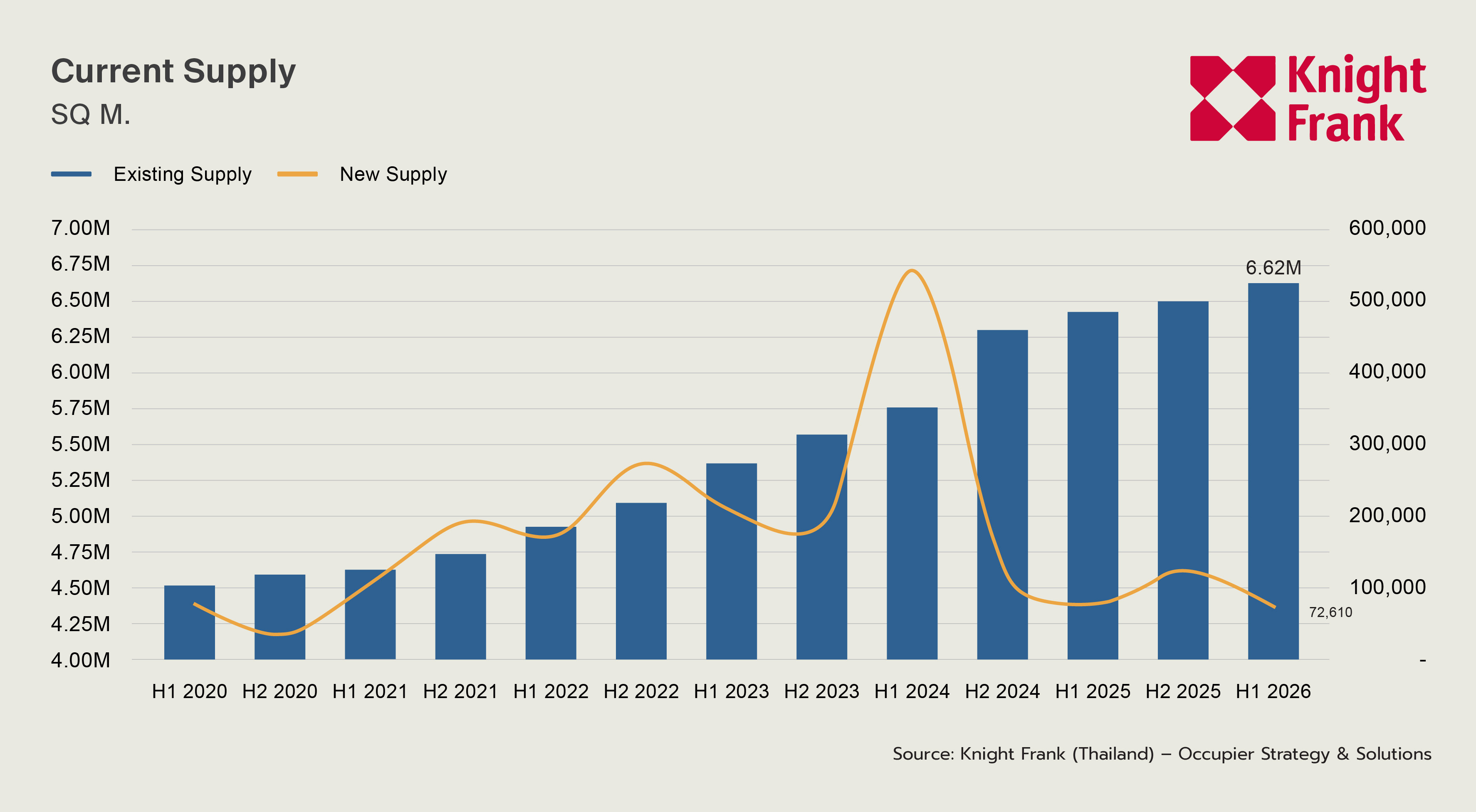
Total warehouse stock increased from approximately 6.62 million sq m at the end of 2025 to 6.69 million sq m in H1 2026, following the addition of 72,610 sq m of new supply. This represented growth of 1.1% half-on-half and 3.0% year-on-year.
Although new supply was slightly below the 75,900 sq m delivered in H1 2025, overall completions remained relatively stable. This reflected developers’ continued preference for phased project expansions and selective new launches.
Expansions in Samut Prakan and Chonburi accounted for 74% of total new supply, while newly completed projects in Rayong contributed the remaining 26%. Samut Prakan added 32,670 sq m, followed by Chonburi with 20,800 sq m and Rayong with 19,140 sq m.
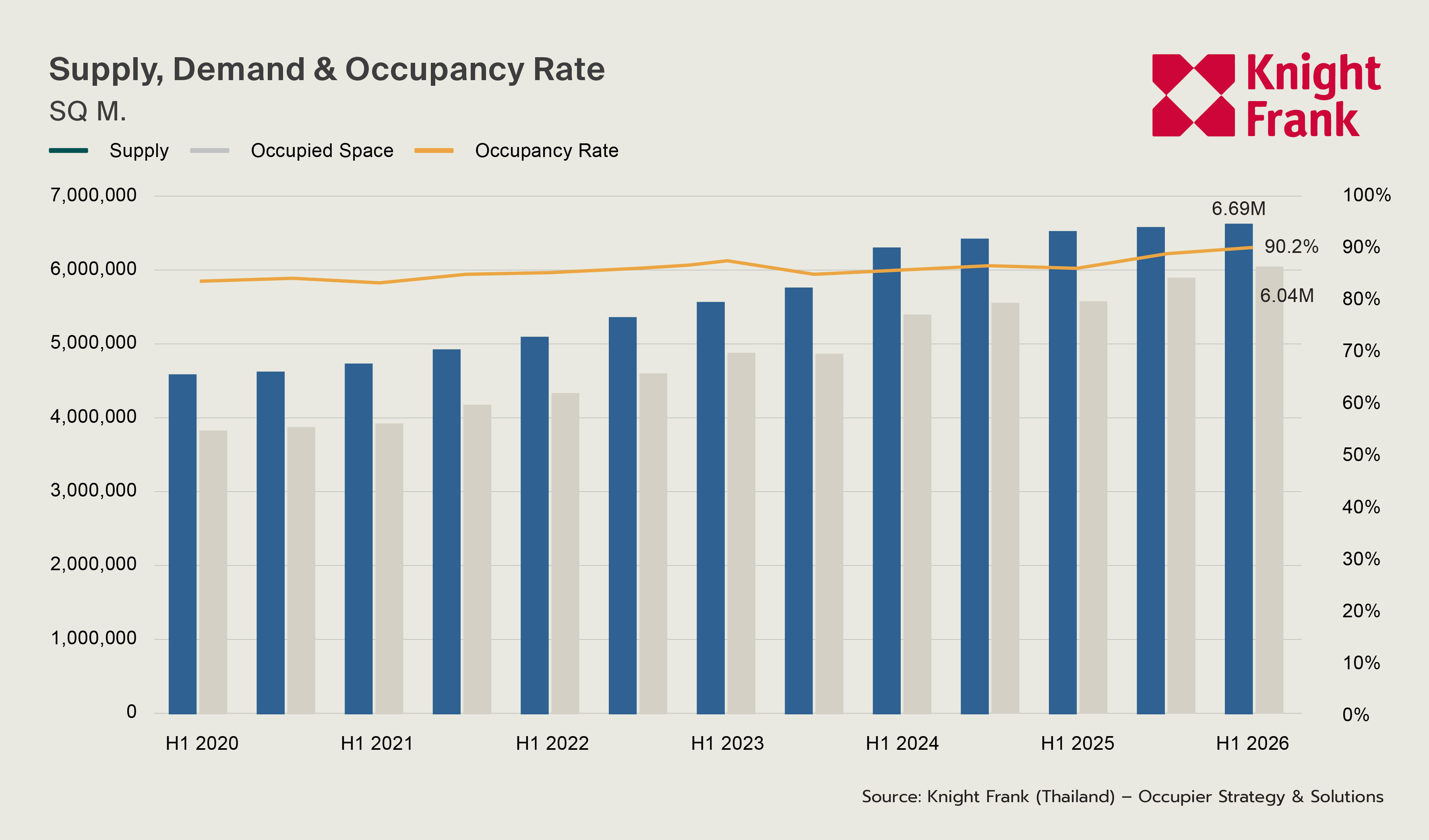
While total supply increased by 3.0% year-on-year, occupied space grew at a significantly faster rate of 8.2%, reaching 6.04 million sq m. This lifted the nationwide occupancy rate by 4.4 percentage points year-on-year to 90.2%.
The stronger growth in occupied space relative to supply indicates that the market continued to absorb new completions without generating meaningful vacancy pressure. It also points to broad-based demand across Thailand’s principal industrial and logistics markets.
Marcus Burtenshaw, Partner and Head of Industrial Strategy & Solutions at Knight Frank Thailand, said: “Thailand’s ready-built warehouse market is entering a healthier and more balanced phase of expansion. The improvement reflects more than new leasing activity alone. Occupiers are also retaining their existing facilities, while newly completed supply continues to be absorbed without creating significant vacancy pressure.”
Net absorption rebounds more than sevenfold
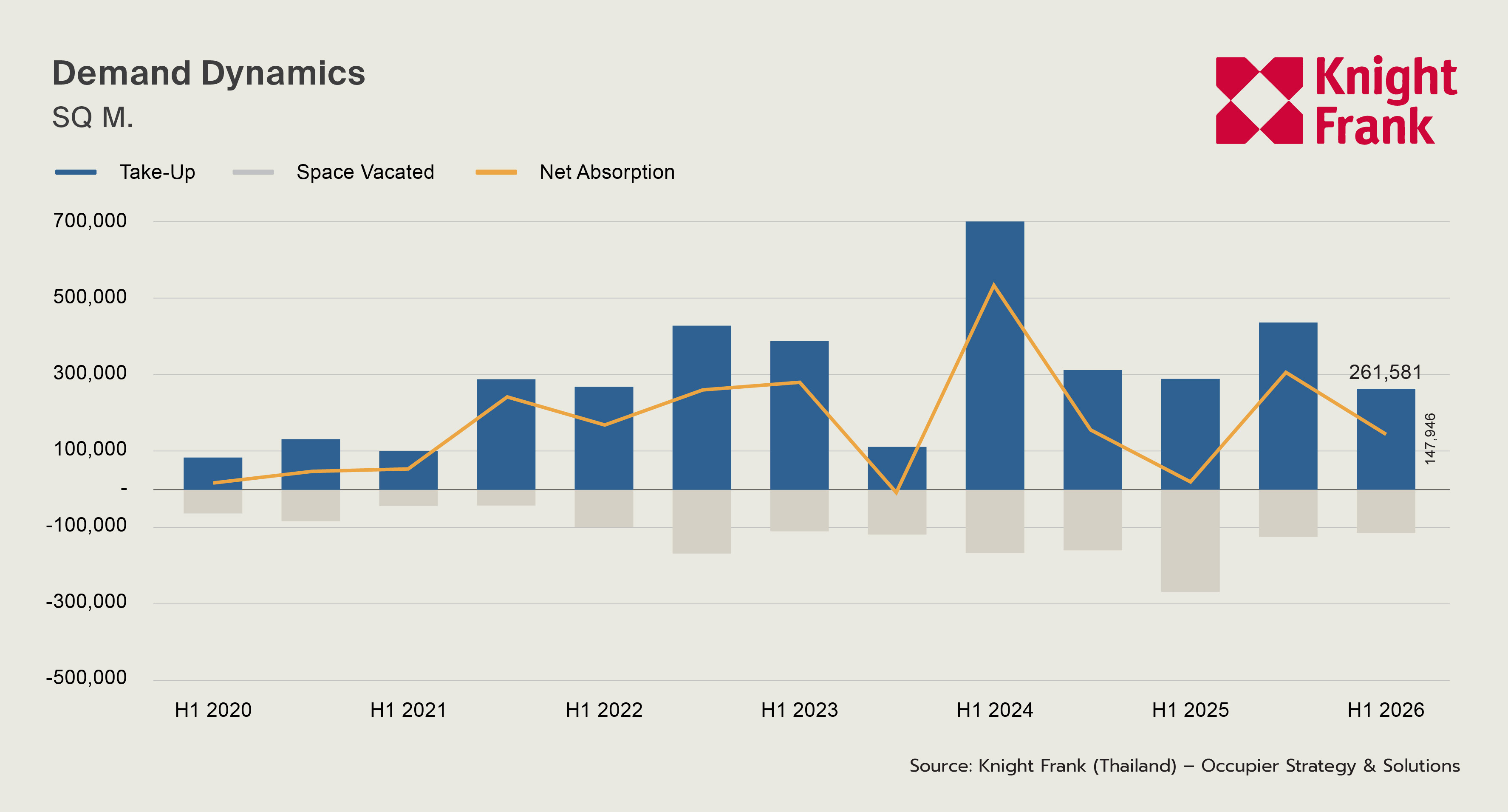
Warehouse take-up reached approximately 261,581 sq m in H1 2026. Although this was below the exceptional level recorded in H2 2025, it continued to reflect solid occupier demand.
Net absorption reached 147,946 sq m, increasing more than sevenfold from 20,335 sq m in H1 2025. Activity was driven primarily by demand in the EEC, followed by the BMR.
The improvement in net absorption was not solely the result of new leasing volumes. Lower levels of vacated space and occupiers’ continued retention of their existing facilities also contributed to the stronger increase in occupied space.
Demand was further supported by improving economic, trade and manufacturing activity. In Q1 2026, Thailand’s exports increased by 17.8% year-on-year, while private investment expanded by 10.1%—the fastest rate of growth in 14 quarters.
Higher imports of machinery, raw materials and intermediate goods, together with inventory accumulation for a second consecutive quarter, supported demand for facilities used to store raw materials, components, work-in-progress inventory and finished products awaiting distribution or export.
Thailand’s transportation and storage sector expanded by 3.6% year-on-year in Q1 2026. Warehousing and logistics support activities grew by 4.5%, while postal and courier services increased by 12.0%, supported by the continued expansion of e-commerce and last-mile delivery.
Demand improves across all major markets
The BMR remained Thailand’s largest warehouse market, accounting for 44.4% of national net lettable area, followed by the EEC at 39.8% and the Central region at 15.5%.
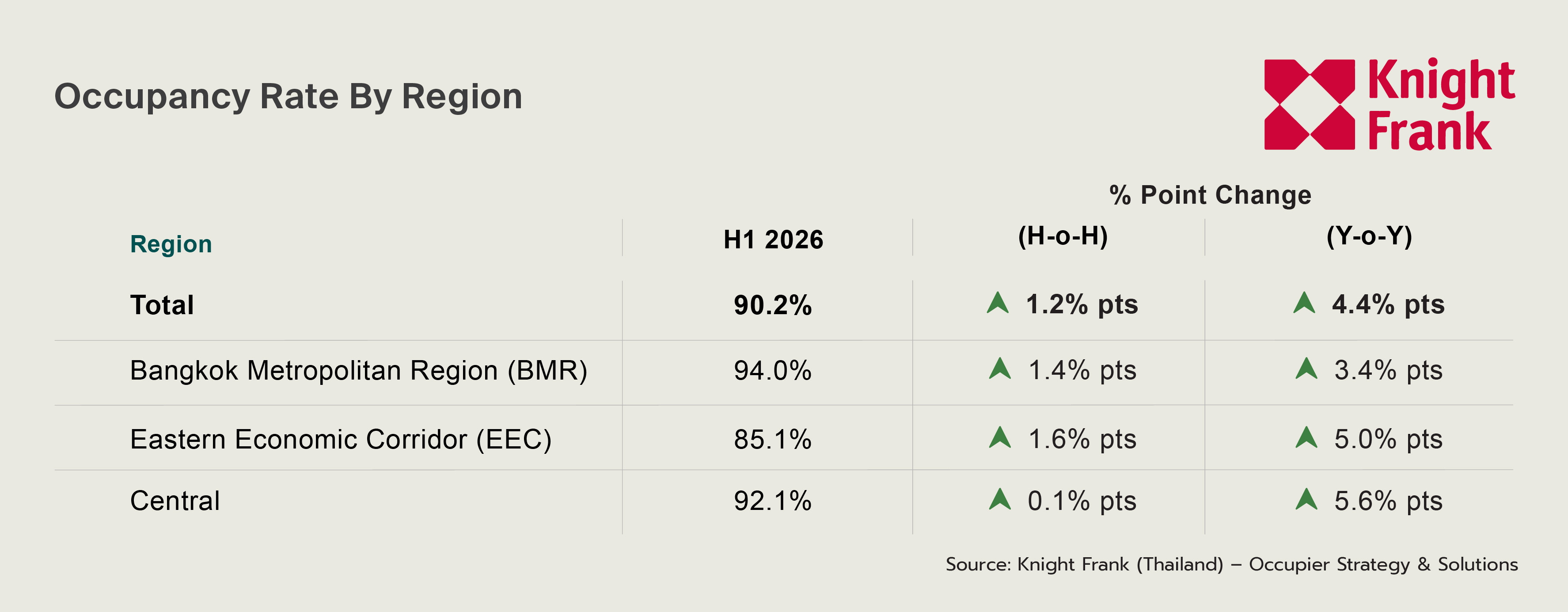
The BMR recorded the highest occupancy rate at 94.0%, increasing by 1.4 percentage points half-on-half and 3.4 percentage points year-on-year. Demand continued to be supported by the region’s role as a major distribution hub, its proximity to a large consumer base and its access to key transport networks.
Occupancy in the Central region reached 92.1%, rising by 0.1 percentage points half-on-half and 5.6 percentage points year-on-year. No new supply was added during H1 2026, indicating that demand remained firm against a relatively stable stock base.
The EEC’s occupancy rate improved to 85.1%, increasing by 1.6 percentage points half-on-half and 5.0 percentage points year-on-year. The region also recorded the fastest supply growth during the period, supported by both phased project expansions and newly completed developments.
Measured rental growth reflects balanced market conditions
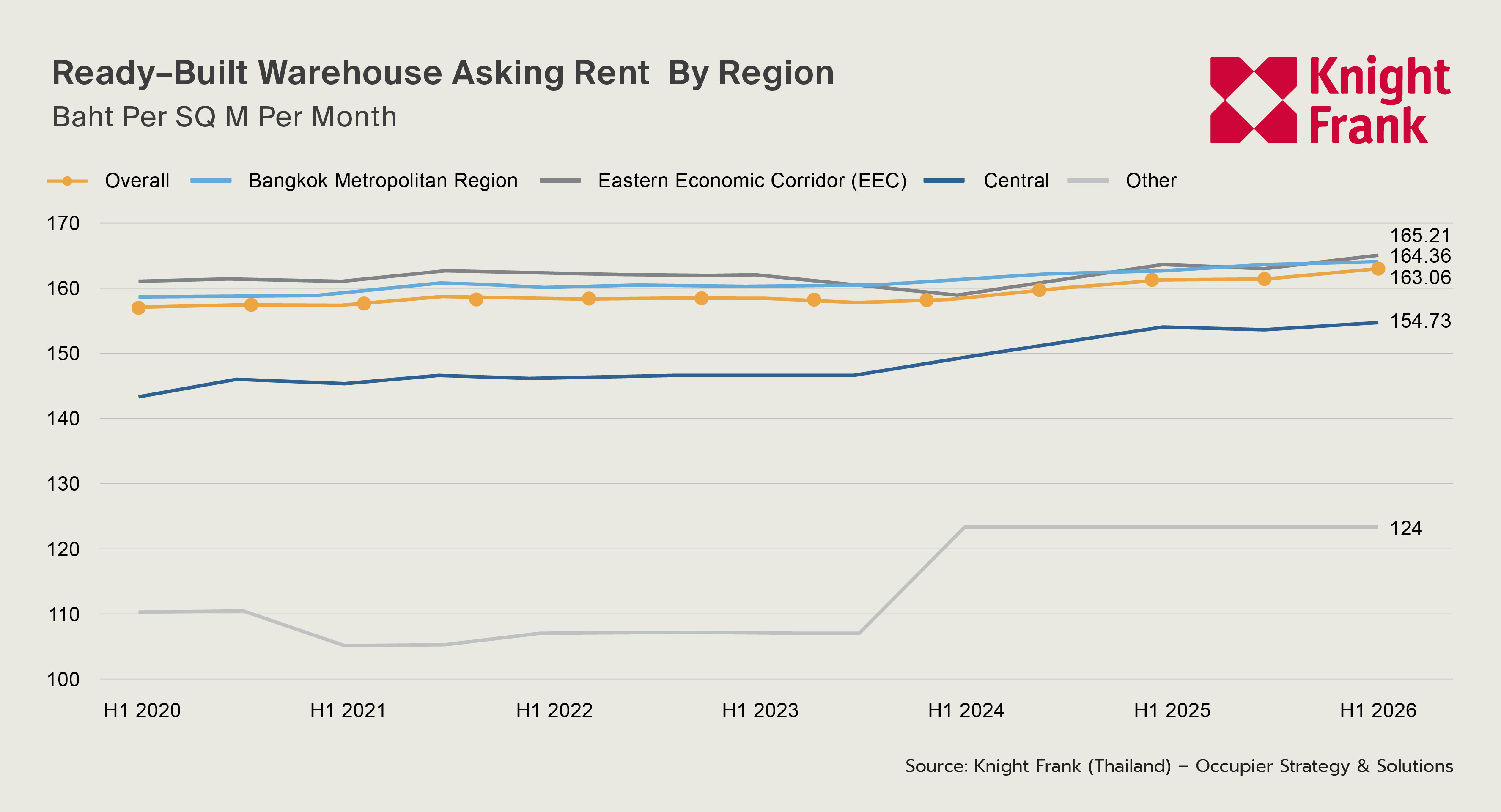
Despite stronger occupancy and net absorption, rental growth remained measured. The nationwide average asking rent increased from THB 161.7 per sq m per month in H2 2025 to THB 163.1 in H1 2026, representing growth of 0.8% half-on-half and 1.0% year-on-year.
The EEC recorded the highest average asking rent at THB 165.2 per sq m per month, up from THB 163.1 in the previous half. The increase was supported by stronger occupier demand and improving occupancy.
Average asking rents in the BMR stood at THB 164.4 per sq m per month, followed by the Central region at THB 154.7 and other regions at THB 124.0.
The modest increase in rents, alongside improving occupancy and net absorption, indicates that the market is not experiencing demand-driven overheating. Instead, supply growth remains broadly aligned with occupier requirements.
Over 426,000 sq m of future supply scheduled for delivery
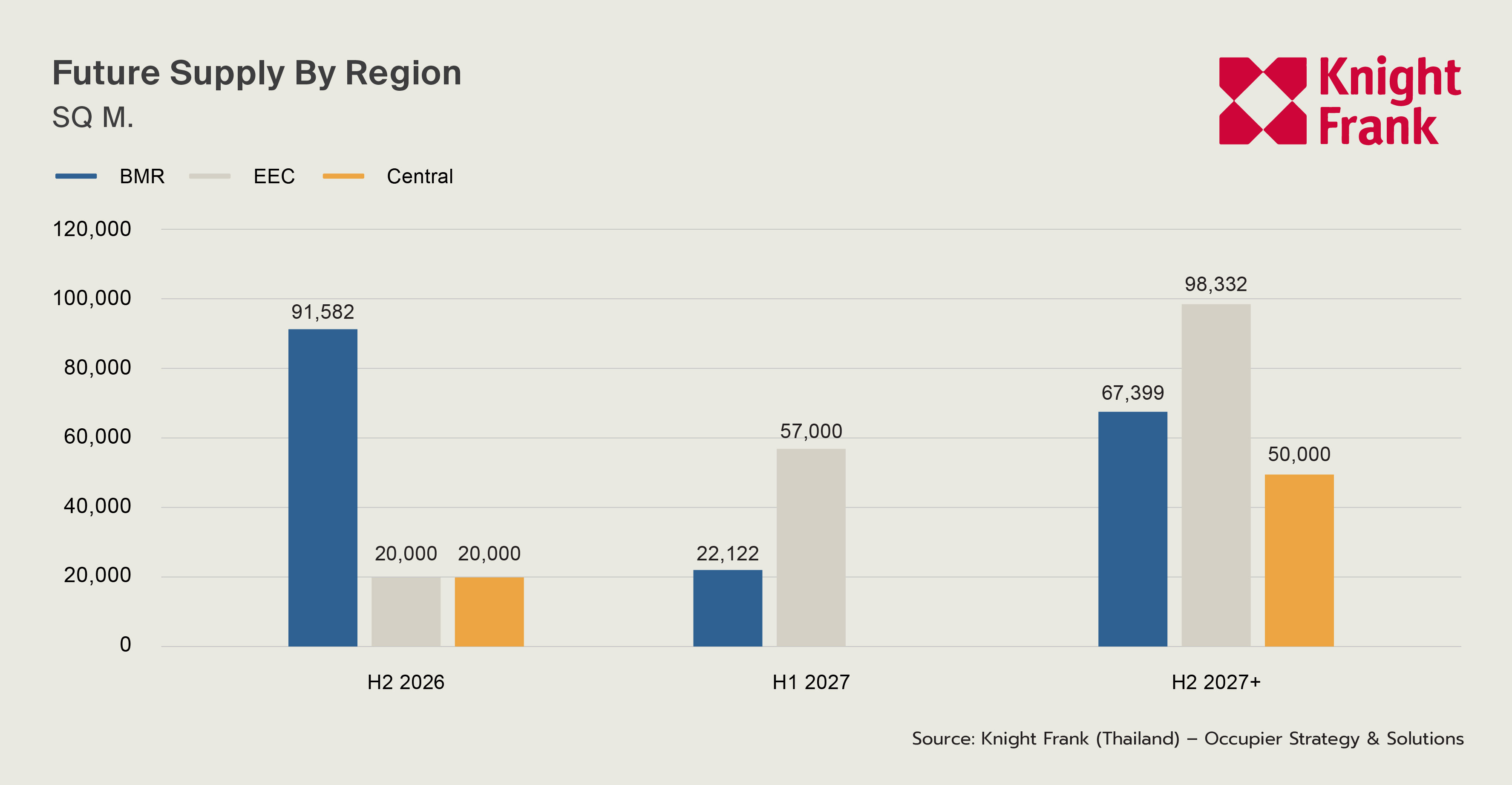
Although new supply remained limited in H1 2026, completions are expected to accelerate from the second half of the year. A total of 131,582 sq m is currently under construction and scheduled for delivery in H2 2026.
This comprises 91,582 sq m in the BMR, 20,000 sq m in the EEC and 20,000 sq m in the Central region.
A further 294,853 sq m is scheduled for completion from 2027 onwards, bringing the total future pipeline from H2 2026 to 426,435 sq m.
Of this pipeline, 42.5%, or approximately 181,103 sq m, is concentrated in the BMR, while 41.1%, or approximately 175,332 sq m, is located in the EEC. The Central region accounts for the remaining 16.4%, or 70,000 sq m.
The concentration of future supply in the BMR and EEC reflects developers’ continued focus on Thailand’s principal industrial and logistics hubs. The resumption of development in the Central region, following four consecutive quarters without new supply, also signals renewed investment activity, although planned development remains significantly below that of the BMR and EEC.
Despite the larger pipeline, a significant proportion of space under development has already been pre-committed. Developers also continue to favour phased delivery and projects supported by identified occupier demand rather than large-scale speculative construction.
Marcus said: “A larger pipeline does not automatically indicate that the market is moving towards oversupply. Location, delivery timing, asset quality and the proportion of pre-committed space must all be considered. The continued use of phased development and pre-leasing strategies is helping maintain supply discipline and limit the risks associated with speculative construction.”
Competition shifts from space volume to asset quality
Competition within Thailand’s warehouse market is expected to become increasingly quality-driven as manufacturing processes become more technology-intensive and occupiers place greater emphasis on efficiency, operational continuity and scalability.
Facilities capable of supporting automation, providing higher building and utility specifications, offering flexible expansion options, and connecting efficiently with manufacturing clusters, ports, airports and major transport infrastructure will be increasingly well positioned.
Prime warehouse assets in the BMR and EEC are therefore expected to maintain stronger occupancy and operating performance, supported by their integration with established industrial clusters and logistics networks. Older facilities and projects in secondary locations that cannot meet occupiers’ evolving requirements for technology, efficiency and flexibility may face greater pricing competition and longer leasing periods.
“Looking ahead, market risk will not be determined by the volume of new space alone, but by how effectively future supply meets occupiers’ operational requirements. Competition is shifting from the quantity of available space towards asset quality, readiness and integration with manufacturing and logistics networks,” Marcus concluded.
Overall, although new warehouse deliveries are set to accelerate from H2 2026, high occupancy, positive net absorption, pre-committed space and phased development strategies should help the market maintain a healthy balance. Developers will, however, need to prioritise location, building quality and clearly identified occupier demand rather than compete on space volume alone.
View Full Report: Click