

Thailand Hotel Market Shifts Focus to Revenue Quality Over Occupancy Growth
05 October 2026
Hotel Market Shifts Its Competitive Focus Towards “Revenue Quality” Rather Than Occupancy Growth
“A hotel with higher occupancy is no longer necessarily the hotel delivering the strongest profitability." This best reflects Thailand's hotel market in the first half of 2026, as the industry shifts from competing primarily for occupancy towards competing on Revenue Quality. Rising hotel supply, increasing operating costs, and evolving guest expectations mean that maintaining high occupancy alone is no longer sufficient to drive sustainable revenue and profitability.
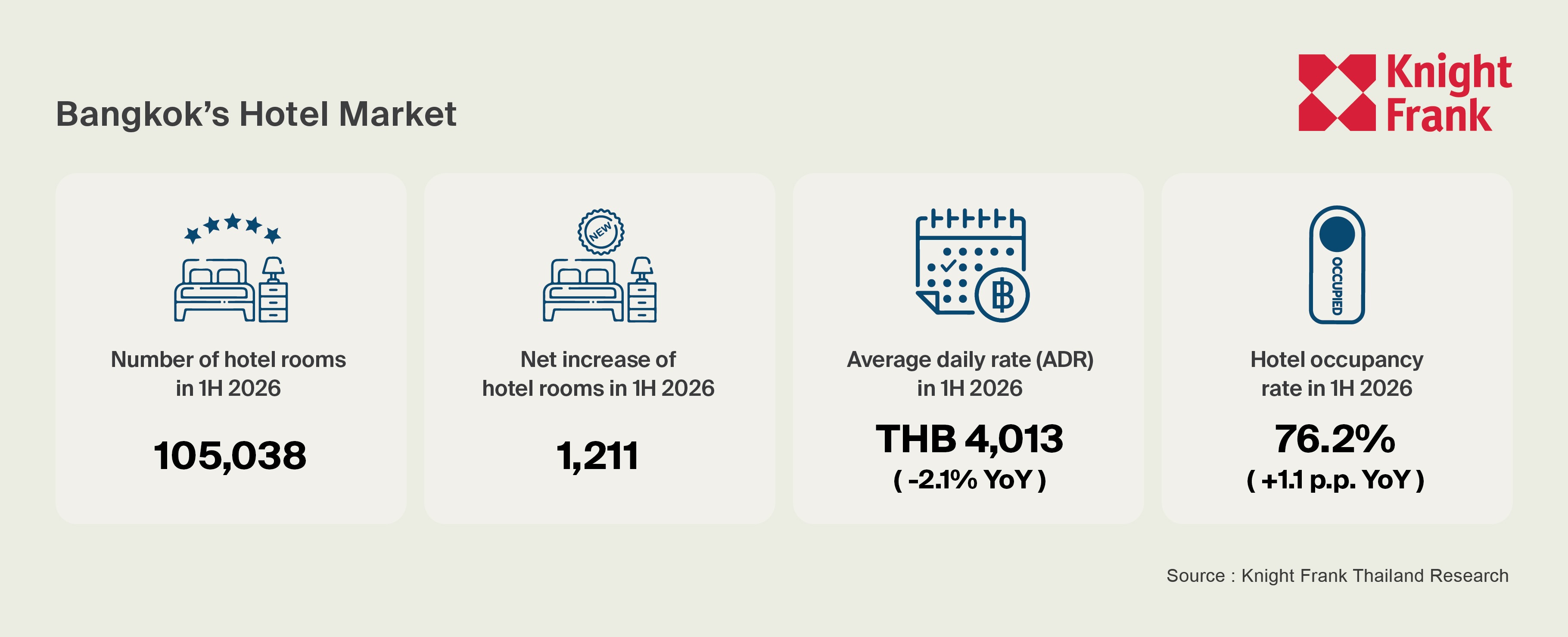
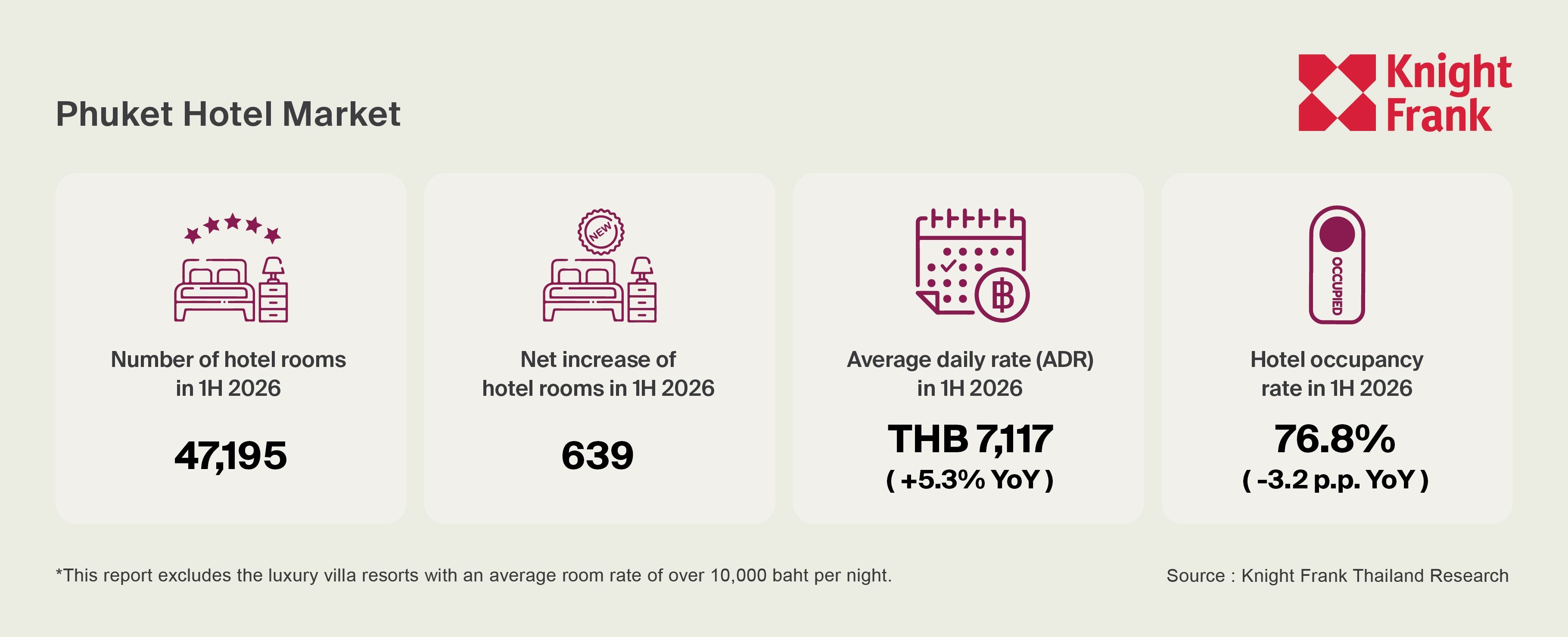
Knight Frank Thailand's latest Hotel Market Research revealed that Thailand welcomed 15.87 million international visitors during the first half of 2026, down 4.9% year-on-year. However, hotel market performance varied significantly by destination. Bangkok continued to benefit from its diversified demand base, supported by corporate travel, MICE, medical tourism, domestic travel, shopping, and international events, resulting in an improvement in average occupancy to 76.2%. Phuket, meanwhile, maintained strong pricing power despite seasonal declines in occupancy.
Knight Frank noted that occupancy alone is no longer an adequate measure of hotel performance.
"Historically, hotel performance was largely measured by visitor numbers and occupancy. Today, those indicators alone are no longer enough. A hotel with high occupancy does not necessarily generate stronger returns if it cannot maintain room rates, manage costs efficiently, or diversify its revenue streams beyond room sales." said Carlos Martinez, Director, Research & Consultancy, Knight Frank Thailand
The research highlights this structural shift clearly. In Bangkok, occupancy increased by 1.1 percentage points year-on-year, yet Average Daily Rate (ADR) declined by 2.1%, resulting in a 0.6% decrease in Revenue per Available Room (RevPAR). Conversely, Phuket experienced a 3.2 percentage-point decline in occupancy, but achieved 5.3% ADR growth, allowing RevPAR to increase by 1.1%. These contrasting results demonstrate that pricing power and value creation have become more influential drivers of hotel performance than occupancy alone.
Knight Frank believes this trend reflects changing traveller behaviour alongside intensifying competition from new hotel supply. Guests can now compare prices, product quality, and guest experiences more easily through online booking platforms, increasing pricing pressure on hotels with similar offerings, particularly within the upscale segment, while properties with stronger brand positioning or differentiated guest experiences are better able to defend their rates.
At the same time, hotel operators continue to face mounting cost pressures, including higher minimum wages for qualifying hotels, rising energy costs, increasing online distribution expenses, and higher customer acquisition costs. As a result, maintaining occupancy at previous levels no longer guarantees comparable profitability.
Looking ahead, Knight Frank expects hotel competitiveness to be determined by a broader range of revenue management capabilities rather than occupancy alone. These include pricing strategy, distribution efficiency, food and beverage (F&B) performance, events and meetings, wellness offerings, and other ancillary revenue streams beyond guestrooms.
For the second half of 2026, demand is expected to remain supported by business travel, MICE activity, international tourism, and major events across key destinations. Nevertheless, factors such as international air capacity, the performance of individual source markets, corporate travel budgets, and the pace of new hotel openings are expected to have a greater influence on hotel performance than headline visitor growth.
Knight Frank concluded that while Thailand's tourism sector continues to benefit from government support measures and the recovery of selected international markets, the medium-term success of hotel operators will increasingly depend on effective asset management, product differentiation, and disciplined cost management, rather than visitor growth alone.
Read Full Report: Click