

Premium Hotels Raise the Competitive Benchmark in Bangkok and Phuket
18 August 2026
Premium Hotels Are Reshaping Competition and Raising the Benchmark in Bangkok and Phuket
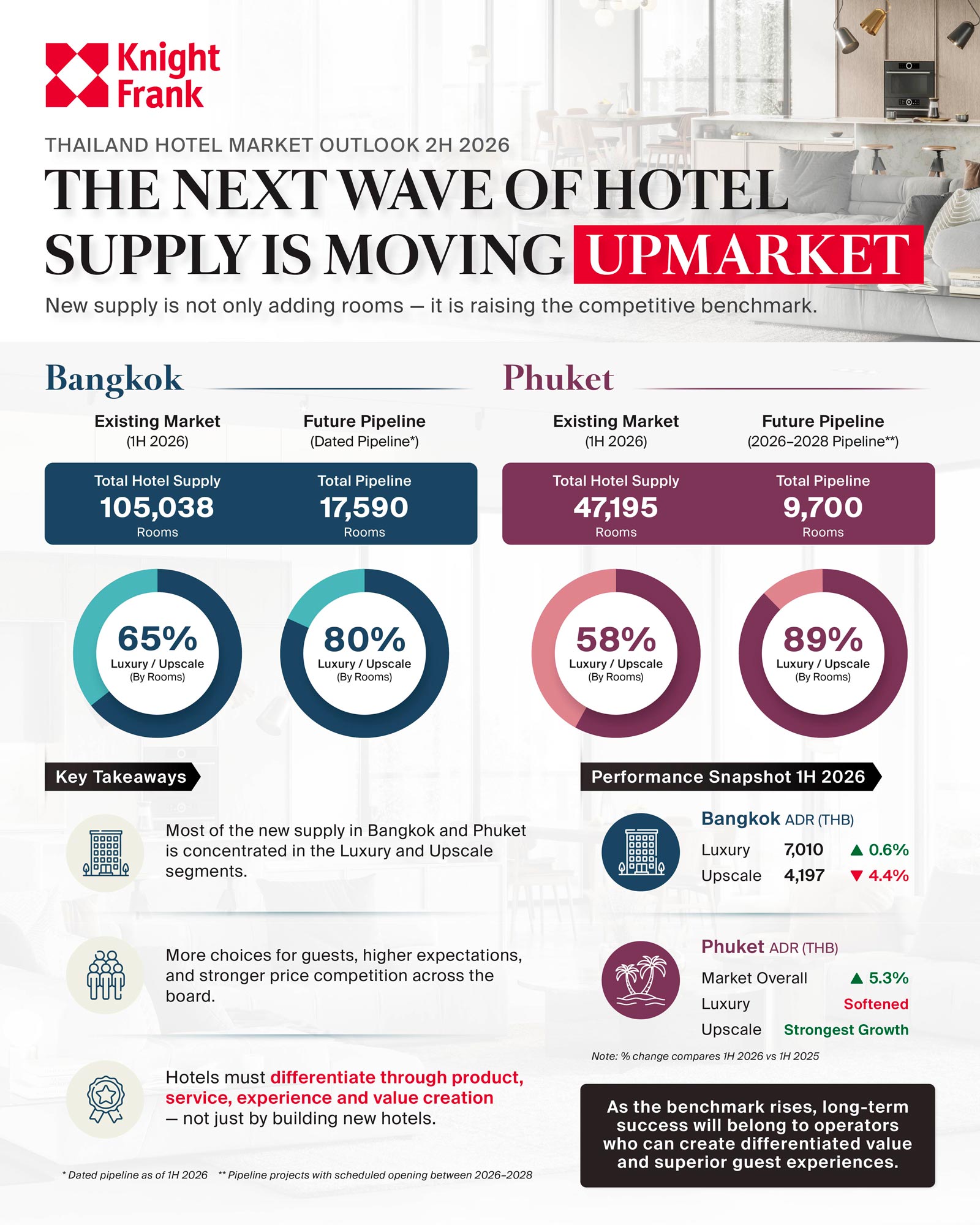
Thailand's hotel market is entering a new phase of competition. A growing share of future supply in Bangkok and Phuket is concentrated in the luxury and upscale segments, and this wave of premium development is doing more than adding rooms: it is raising the benchmark for product quality, service and guest experience against which every existing hotel will be judged.
According to Knight Frank Thailand's latest Hotel Market Research, Bangkok ended 1H 2026 with 105,038 hotel rooms, of which approximately 65% were in the luxury or upscale segments. The tracked development pipeline stands at approximately 17,590 rooms — equivalent to 16.7% of operating supply — with around 80% of dated pipeline positioned as luxury or upscale. The 2027 schedule alone contains approximately 7,635 rooms.
Phuket is moving in the same direction within its resort market. The island ended the half-year with 47,195 rooms, approximately 58% of them in the luxury or upscale segments. Of the rooms scheduled for delivery between 2026 and 2028 — including 1,460 in 2027 and 1,193 in 2028 — approximately 89% are positioned in the luxury or upscale categories.
The direction of new supply is consistent with Thailand's tourism strategy, which prioritises generating greater value per visitor over volume alone. The Tourism Authority of Thailand's 2026 strategy emphasises higher-value travel and experiences, while hotel owners and operators are looking beyond guestrooms to F&B, wellness, events, lifestyle offerings and, in selected resort developments, branded residences.
However, 1H 2026 performance already shows that a premium address does not guarantee premium results. In Bangkok, luxury ADR was broadly stable at THB 7,010, up 0.6% year-on-year, while upscale ADR declined by 4.4% to THB 4,197 — rate pressure was concentrated where expanding branded choice and online price transparency make it easiest for guests to compare and substitute. Phuket retained stronger destination-level pricing power, with overall ADR up 5.3% to THB 7,117 despite a 3.2-percentage-point decline in occupancy; at the segment level, upscale hotels recorded the strongest rate growth, followed by midscale, while luxury ADR softened.
“The growing concentration of new supply at the upper end of the market does not mean that developing a luxury hotel guarantees success. What it does mean is that the competitive benchmark is rising. As guests are presented with more choice, hotels need to give them a compelling reason to choose their property — and to pay the rate being asked,” said Carlos Martinez, Director of Research & Consultancy, Knight Frank Thailand.
Competition is also becoming more localised. In Bangkok, near-term development is concentrated along the Sukhumvit corridor — through Thonglor, Ekkamai and Phra Khanong — with a secondary cluster around Ratchathewi–Siam, while new and relaunched properties in Sathorn and Surawong broaden modern branded inventory beyond the traditional core. In Phuket, projects are spread across Bang Tao, Kata and the southern and southeastern resort areas, including Chalong, Rawai and Nai Harn, extending new supply well beyond the historic Patong concentration. In both destinations, hotels with similar positioning, price points and target customers will increasingly compete head-to-head within the same submarkets.
For existing owners, the practical question is whether their product remains competitive as new-generation hotels reset guest expectations. The response does not require complete redevelopment: refurbishment, repositioning, stronger F&B and event concepts, wellness and family offerings, and more effective distribution can all keep established hotels relevant. In Phuket, branded residences can also support the economics of selected high-end resorts, although the model places greater importance on careful phasing, consistent brand standards and long-term resort management.
“Future competition will not be about who has the newest hotel, but about who creates the most differentiated value for guests — who increasingly choose on experiences, wellness and personalisation rather than accommodation alone. As more premium properties open, existing owners and operators will need to keep upgrading their assets — competition is now shaped as much by the quality of supply entering the market as by visitor numbers,” Mr Martinez added.
Delivery schedules remain fluid. Rising construction costs — which Knight Frank expects to increase by approximately 3–5% in 2026 — infrastructure constraints, approvals and project phasing may delay some openings and increase the appeal of conversions and refurbishment. Existing operators should not, however, rely on slippage to blunt future competition. The pipeline points in one clear direction: the benchmark for hotel products in Bangkok and Phuket is moving higher, and the hotels best placed to defend their rates will be those that differentiate through product, service and execution rather than compete on price alone.
View Full Report: Click