

Manufacturing Market 2H 2024
The Thai economy gained momentum in the third quarter of 2024, achieving its highest growth this year. GDP grew by 3.0% (Y-o-Y), driven by strong growth of goods export and accelerated public investment execution, which bolstered construction activity.
12 March 2025
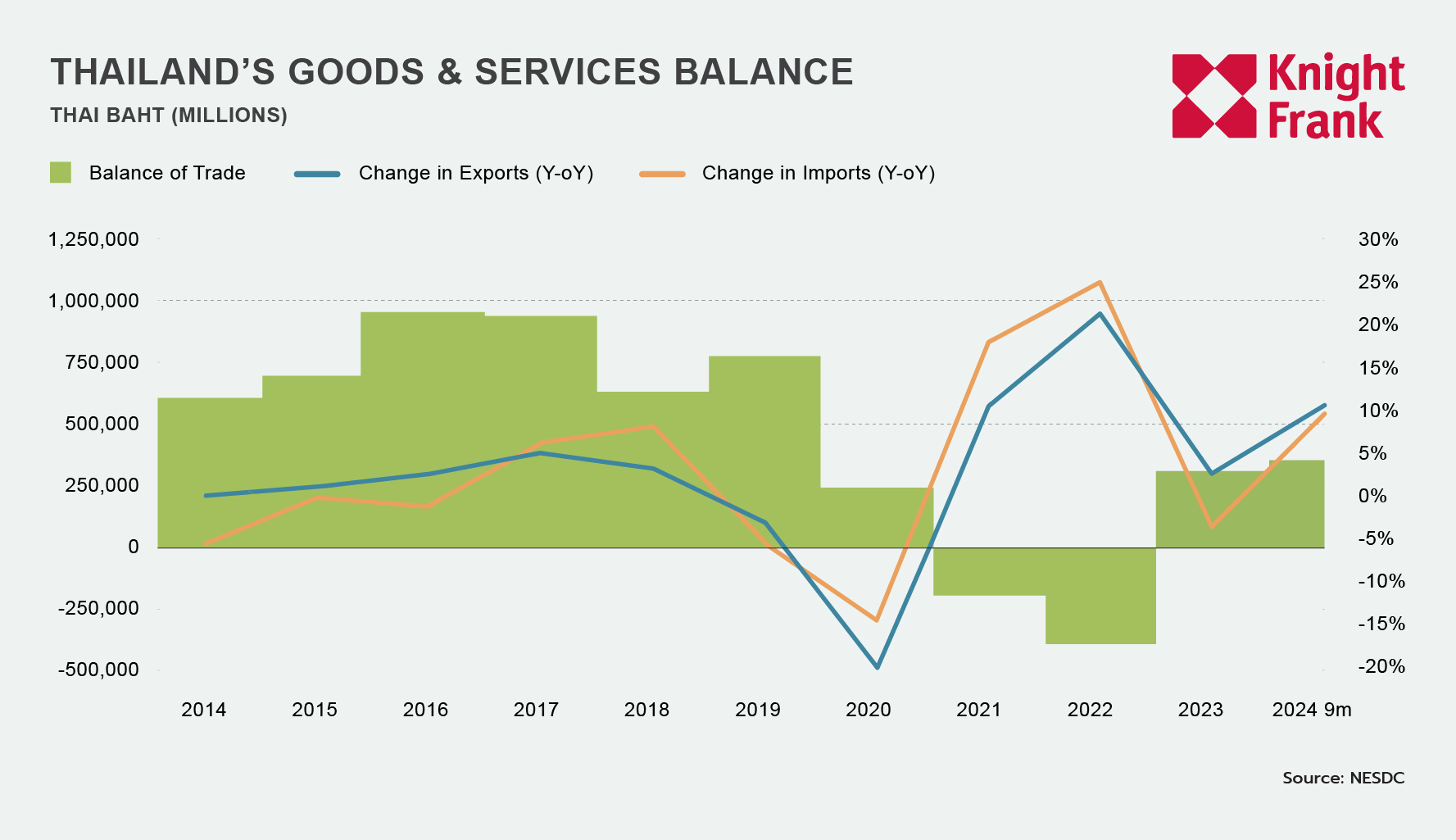
In the first nine months of 2024, Thailand maintained a positive trade balance, driven by a 10.6% increase in exports of goods and services, which outpaced the 9.8% growth in imports. Private consumption slowed down with a growth of 1.7%, attributed to tighter credit conditions, delayed consumer decisions, and an ongoing decline in spending on durable goods, including a sharp contraction in automobile purchases amid ongoing price competition in EVs. Government expenditure also experienced a 1.6% increase, driven by government spending stimulus measures, especially the first phase of the 10,000 Baht project, along with a 1.1% increase in employee compensation. Meanwhile, fixed capital investment contracted by 1.7%, primarily due to an investment reduction in automotive and private construction. This decline in fixed capital investment, partly due to tight credit standards and reduced lending for equipment and construction, reflects broader financial constraints and weakening business sentiment.
Inflationary pressures in Thailand remained subdued during H2 2024, with headline inflation averaging just 0.6%. This moderation was largely attributed to declining energy costs, as electricity and fuel prices fell, alongside easing food prices driven by improved domestic supply conditions. The government’s continued subsidies on diesel and electricity played a key role in maintaining affordability for households and businesses. However, core inflation remained slightly higher due to persistent price increases in particular non-food categories, reflecting structural cost pressures. Thailand’s inflation rate in the latter half of the year was among the lowest in the region, underscoring the country’s relative stability amid global economic uncertainties.
In October 2024, Thailand’s manufacturing productivity index (MPI), after seasonal adjustment, remained steady at 96%, showing stability compared to the mid-year figure. This level reflects an ongoing recovery in the manufacturing sector despite ongoing challenges, including a lack of domestic purchasing power and an influx of cheaper imported goods into Thailand, shifting consumer preferences away from buying local products. Additionally, tightened credit approval significantly impacted key industries, such as the automotive sector, leading to a notable contraction in production from pickup trucks, small passenger cars, and hybrid cars.
Read more the full report click